
What I wish someone had told me on day one, and a few things I had to learn the hard way.
I’ve been running WordPress hosting for 18 years.
The first site I hosted was for a small printing company in 2008. Shared cPanel reseller account, $4/month from a wholesaler in Texas. The site went down a week into the contract because a sibling account on the same server had been hacked and the host’s response was to take the whole machine offline for “investigation.” That was a Tuesday. They didn’t bring it back until Friday.
I refunded the customer for the year. Then I went and bought my first VPS.
Eighteen years later, after hundreds of sites, here’s what I wish someone had told me on day one: small businesses don’t need more features. They need fewer problems.
The “unlimited everything” trap
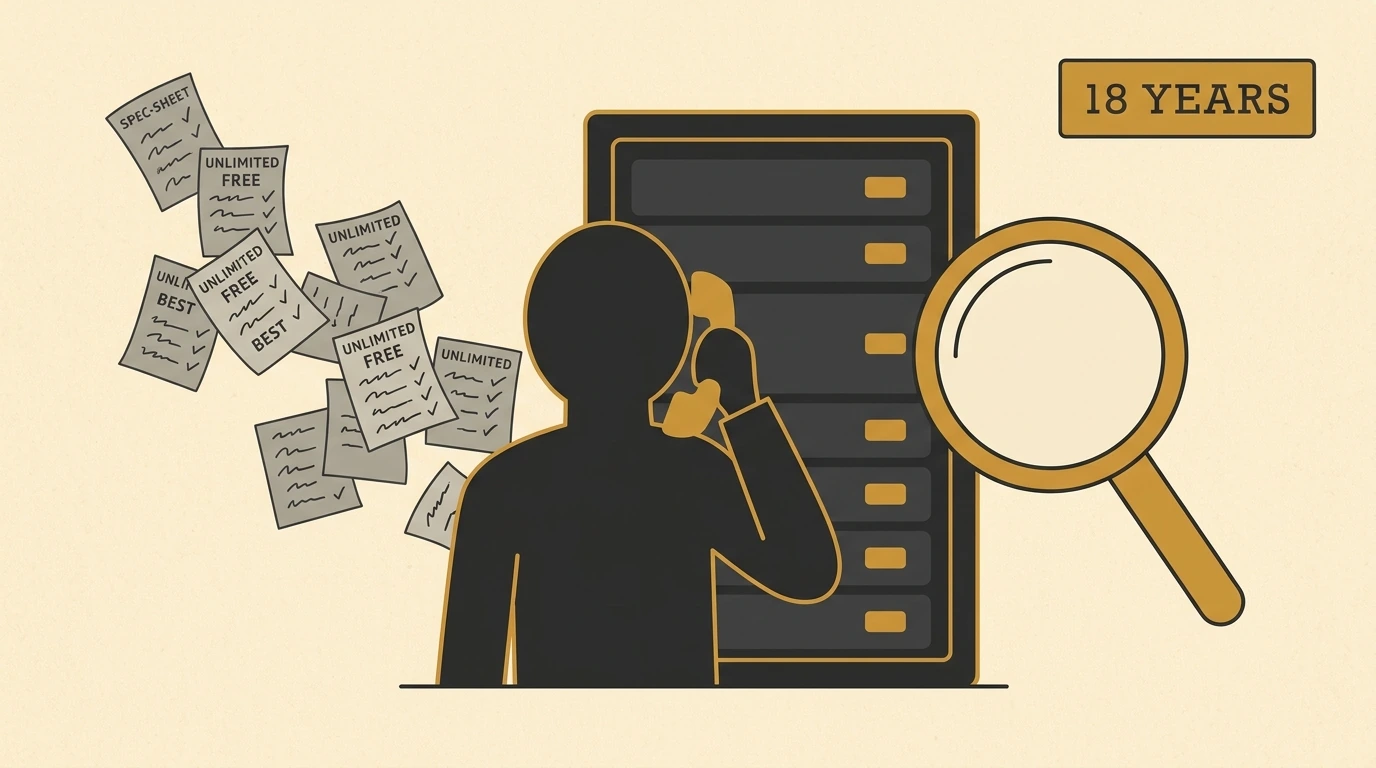
Most hosts compete on specs. Unlimited bandwidth, unlimited storage, unlimited subdomains, unlimited email accounts, unlimited everything. The page is a wall of green checkmarks designed to make a comparison spreadsheet look favorable.
When something breaks at 2am, “unlimited” doesn’t answer the phone.
I had a client a few years back whose site was hosted with one of the big-box providers, the kind that runs Super Bowl ads. Their checkout broke during a launch. They submitted a ticket. Twelve hours later they got a reply asking them to clear their browser cache.
The site was down because the host had migrated their account to new hardware overnight without telling anyone, and the new server had a different PHP version that broke their plugin stack. The “support agent” who replied was reading from a script and had no idea.
We moved that site to my infrastructure the same week. The actual fix took twenty minutes once a human looked at it.
What actually matters
After eighteen years, I’ve reduced what I look for in a host (and what I try to provide) to four things:
- → Someone who picks up when your site goes down and can log in to the server to fix it.
- → Updates that happen before vulnerabilities get exploited. WordPress core, PHP, plugins, themes, the OS. Most “managed WordPress” plans I’ve audited only update WordPress core. The rest of the stack just sits there.
- → Email that just works without a separate bill. Hosting and email got divorced sometime around 2015 and I think it was a mistake. A small business with five inboxes shouldn’t be paying extra for the privilege of receiving customer email at their own domain.
- → Backups you never have to think about. Daily, off-server, restore-tested, and at least 30 days deep. If the only person who knows whether the backup actually works is the person who set it up, the backup doesn’t actually work.
That’s it. Four things. They show up in how a host runs, so none of them appear on a comparison spreadsheet.
Spec-sheet hosting vs. operator hosting
Two ways to run a hosting business:
| Spec-sheet hosting | Operator hosting |
|---|---|
| Pricing optimized for the comparison page | Pricing optimized for the work it actually takes |
| Support tier-1 reads from a script | Support is the person who’d fix it themselves |
| Updates happen “as needed” (i.e., never) | Updates are a calendar event, every week |
| Backups exist (untested) | Backups are restored on a rotation |
| The server is the product | The relationship is the product |
The spec-sheet model wins on growth and margin. The operator model wins on retention and word-of-mouth. I’ve watched plenty of agencies and freelancers try to do operator-grade work on spec-sheet-grade infrastructure and it always ends the same way: they’re personally on the hook for someone else’s outage.
The thing nobody talks about
The unsexy lesson, eighteen years in, is that most hosting problems are caused by other hosting problems. A plugin that needs an emergency security update was already two major versions behind because nothing was tracking it. A backup that was supposed to restore in five minutes takes two hours because nobody’s tested it since 2021. An email outage that lasted six hours was actually a DNS misconfiguration from a migration two years prior that nobody documented.
The operator approach is mostly about not letting small things become compounding ones. It’s not glamorous. It rarely makes a good demo. It mostly looks like nothing happening, which is exactly what the customer is paying for.
Three takeaways, eighteen years in
1. The cheapest host is the most expensive one. Every hour you spend troubleshooting is an hour you didn’t spend on revenue, and cheap hosting moves its costs onto your time.
2. Operations are the moat. Anyone can rent a bigger VPS; almost nobody builds the discipline to run it well.
3. Reliability is the whole product. Performance, security, scalability and fancy admin panels are all sub-properties of one question: does this site stay up and stay correct, all the time, without me having to think about it? Get that right and the rest is detail. Get it wrong and the rest is theater.
Tell me through the contact form: what’s the worst thing a host has put you through, and what made you switch?